
You passed the exams. You got registered. And now you are sitting there wondering what you are actually supposed to do on Monday.
That feeling is normal. Nobody really prepares you for it.
If you are planning your first 30 days as a real estate agent in Ontario, here is the goal. Not to look busy. To build the foundation for a real business.
This is a first-month action guide, not another general career-advice article. Over the next four weeks you will set up your systems, get visible, learn the work before you handle clients alone, and start real conversations. You do not need it all figured out by day one.
TL;DR
- Confirm your RECO registration and brokerage setup.
- Build your CRM and your first 100 to 200 contacts.
- Get visible online.
- Shadow agents, practise the forms, and learn compliance.
- Start warm outreach and follow up after every open house.
At Realty World Legacy, we treat the first 30 days as the Foundation phase of our 90-day onboarding program. We map out systems, tech, branding, brokerage rhythm, mentorship, and accountability before you are ever expected to produce alone. Days 1 to 30 are Foundation. Days 31 to 60 are Pipeline. Days 61 to 90 are Production.

Before Your First 30 Days, Confirm Your RECO Registration Basics
In Ontario, real estate agents are regulated by the Real Estate Council of Ontario (RECO). Your registration runs through RECO, and you cannot trade in real estate until a few pieces are in place.
Check these off before you chase a single lead:
- Pre-registration education is complete.
- Your brokerage employment is confirmed.
- Your RECO application, background check, MyWeb steps, and professional liability insurance are done or underway.
Why it matters: you cannot legally trade until your registration, brokerage employment, application approval, and insurance are all sorted. The pre-registration path includes five courses, two simulation sessions, and six exams, with a maximum 24-month window to finish. You also have to be employed by a brokerage to trade.
One thing trips people up. You will still hear people talk about “OREA steps.” Your registration path is through RECO. OREA matters later, once you start learning the forms and clauses used in Ontario deals.
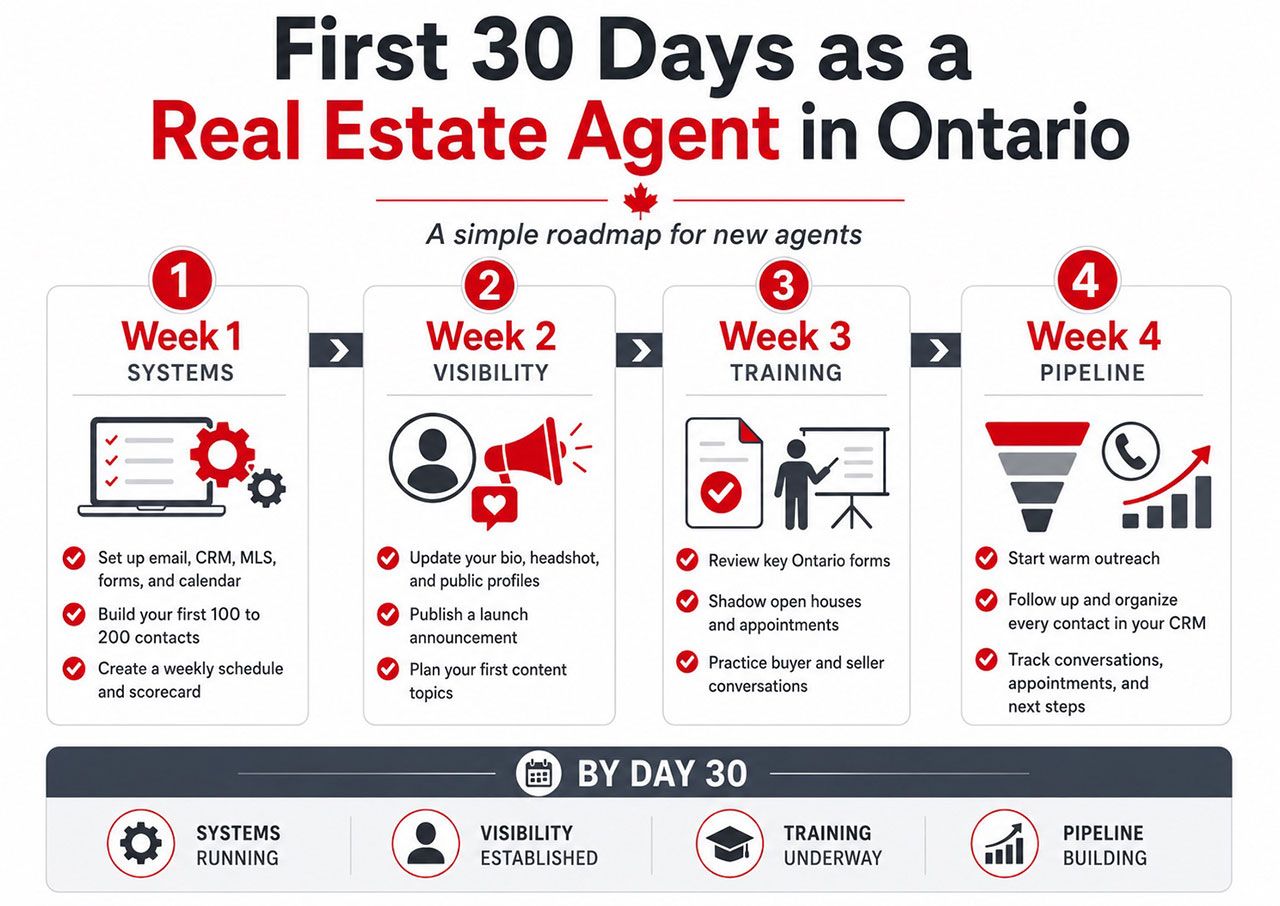
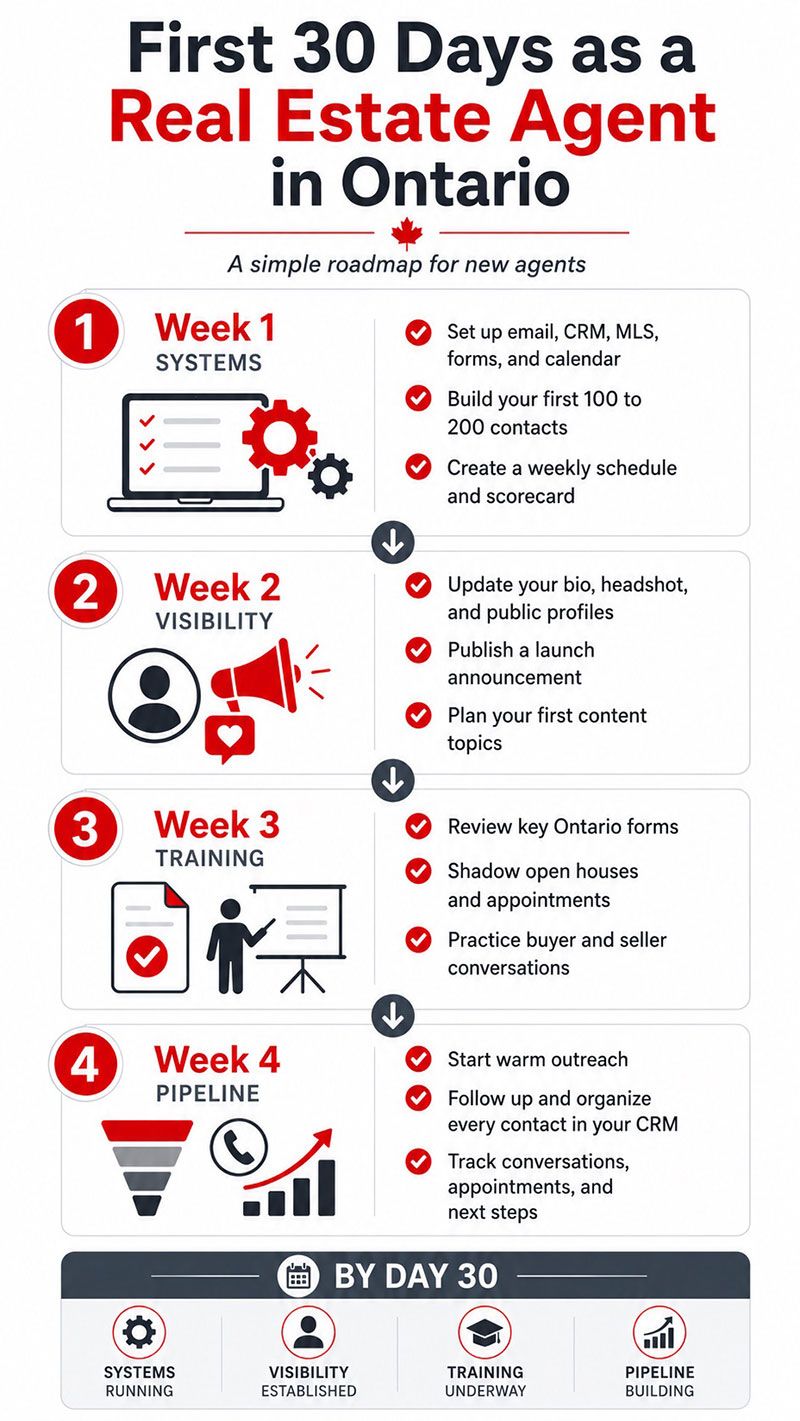
Week 1: Get Operational Before You Chase Leads
Week 1 is setup. It is not glamorous, and it matters more than anything else you do this month.
Start with access. Set up your brokerage email, phone, voicemail, email signature, calendar, CRM, document storage, board access, MLS access, and forms access.
Then meet the people who keep you out of trouble. Your broker, your manager, your mentor, your onboarding lead. Ask them directly: who reviews paperwork, offers, pricing, listing presentations, compliance questions, advertising, and open house procedures?
Next, build your starter database. Pull together 100 to 200 people. Family, friends, past coworkers, neighbours, local businesses, community contacts, and social media connections.
Tag every one of them in the CRM so the list stays useful: buyer, seller, landlord, tenant, investor, referral source, local business, past coworker, or warm personal contact.
Finally, build a weekly schedule. Block time for training, market study, database entry, outreach, content, open houses, and follow-up. Set up a simple first-month scorecard so you can measure activity instead of guessing.
This is exactly what our Foundation phase covers: systems, tech, branding, brokerage rhythm, email, profiles, a starter database, headshots, bio, and signage.
Your Week 1 checklist
- Confirm every login.
- Add your first 100 contacts.
- Schedule your first business-plan meeting.
- Learn who to call before you make a mistake.
- Block your calendar for lead generation before the week fills up.
Week 2: Build Visibility So People Know You Are in Business
Being licensed is not the same as being visible. Week 2 fixes that.
Write a short, clear agent bio. Get a professional headshot. Then update everywhere people might find you: LinkedIn, Instagram, Facebook, your Google Business Profile if you have one, your website bio, your email signature, and your brokerage profile.
Create a simple launch announcement you can send by email, text, and social media.
Do not overthink the brand. The first goal is clarity and visibility, not a perfect logo. Pick a starter local focus to anchor your message, such as Burlington buyers, Halton families, first-time buyers, downsizers, condo owners, lease clients, or a single neighbourhood.
Then set a weekly content rhythm you can actually keep:
- One educational post.
- One local or community post.
- One personal credibility post.
- One direct outreach block.
While you are at it, prepare basic buyer and seller presentation materials. You do not want to be building those in a panic later.
We give new agents brand templates, listing presentations, buyer presentations, business cards, postcards, brokerage signs, and leadership feedback, so you are not starting from a blank page.
Your Week 2 checklist
- Publish your launch announcement.
- Update every public profile.
- Draft your bio.
- Create your first four content topics.
- Prepare buyer and listing presentation templates.
- Add everyone who responds to your CRM.
Week 3: Learn the Work Before You Handle Clients Alone
Week 3 is your confidence week. This is where you learn how Ontario paperwork works in real life, not just in theory.
Treat OREA forms as practical tools, not the licensing authority. Focus first on the documents you will meet early:
- Agreement of Purchase and Sale
- Listing Agreement or Seller Representation Agreement
- Buyer Representation Agreement
- Agreement to Lease
- Disclosure forms
- Offer Summary Document
If you want extra practice, OREA and Humber offer Mastering OREA Forms, a short course for new agents, though it works best alongside the forms training and mentorship your brokerage already gives you.
Reading them alone only gets you so far. Sit with a mentor or broker and walk through a sample buyer file and a sample listing file. Then go shadow the real thing: showings, open houses, buyer consultations, listing appointments, inspections, walkthroughs, and offer conversations.
Practise explaining representation, deposits, conditions, clauses, showings, offer timelines, and next steps in plain language. Learn advertising compliance, open house procedures, FINTRAC basics, document retention, and your local board workflows.
And ask to role-play the conversations that make new agents nervous. Those are the ones you want to rehearse before a client is sitting across from you.
We build paperwork training, compliance training, pricing and offer review, open house support, role-plays, script partners, and leadership review into our program.
Your Week 3 checklist
- Review the most common Ontario forms.
- Shadow at least one open house.
- Practise a buyer consultation.
- Practise a listing conversation.
- Review a mock offer with leadership.
- Learn the process for getting urgent compliance help.
Starting to feel like you want this structure around you? See how our 90-day onboarding program handles forms, compliance, and mentorship so you are never guessing on your own.
Week 4: Start Lead Generation With a System You Can Repeat
Now you shift from setup to activity that creates real conversations.
Start with your warm market. It is the fastest path to a real conversation. Call, text, email, and message the people already in your starter database. Keep the script human:
I’m letting people know I’m now working in real estate in Ontario. I’m focusing on helping people make confident decisions around buying, selling, leasing, or planning their next move. I’d be grateful if you kept me in mind if a real estate question comes up.
Attend or host open houses with support. Follow up with every single visitor. Add every conversation to the CRM, and sort each contact into a follow-up category so you do not lose track of anyone:
- Now
- 30 days
- 90 days
- 6 months
- 12 months
- Referral source
Track your activity before you judge your results. Count calls, conversations, contacts added, follow-ups completed, open house visitors, appointments requested, and nurture opportunities.
Your first month should be judged by habits and pipeline, not commissions. The deals come later, once the habits are already in place.
Our Pipeline phase covers lead generation, scripts, network outreach, and rehearsed conversations, backed by database and campaign tools, network setup, a content cadence, and an open house playbook. If you want a steadier source of conversations while your own pipeline builds, our brokerage-generated lead support helps fill that gap.
Your Week 4 checklist
- Complete 50 to 100 warm outreach touches.
- Host or shadow an open house.
- Follow up with every new contact.
- Set next steps in the CRM.
- Review your activity with a mentor.
- Decide what to carry into your next 30 days.
Common First-Month Mistakes New Ontario Agents Should Avoid
Which of these are you about to make? A few predictable mistakes quietly cost new agents their momentum:
- Waiting until everything is perfect before announcing the business.
- Spending too long on logos, colours, and templates before having conversations.
- Skipping the CRM from day one.
- Treating training as optional once licensed.
- Avoiding role-play because it feels uncomfortable.
- Studying forms alone without asking how they work in live deals.
- Hosting open houses with no follow-up plan.
- Measuring the first month by commissions instead of activity.
- Picking random lead-generation tactics without tracking results.
- Trying to figure everything out alone.
Your first 30 days are about building a rhythm. When the rhythm is missing, new agents drift into reactive work, patchy outreach, and avoidable mistakes.
What Brokerage Support Should Look Like During Your First 30 Days
Your first month is far easier when the brokerage gives you a plan instead of leaving you to invent one.
So as you settle in, or while you are still deciding how to choose your first real estate brokerage, ask the questions that show whether real onboarding exists:
- Who helps me create my first 30-day plan?
- Who reviews my business plan?
- Who sets up my CRM, templates, campaigns, and database structure?
- Who teaches me the brokerage’s paperwork and compliance process?
- Who can I call when I am writing my first offer?
- Can I shadow open houses before hosting alone?
- Are scripts, role-play, and weekly accountability included?
- Is there a defined 30, 60, and 90-day onboarding path?
- What happens after the first month?
At Realty World Legacy, we build leadership, mentorship, role-play, and weekly check-ins into the plan, with daily and weekly steps mapped across 90 days. That includes a one-on-one business plan session, listing and pricing reviews, role-plays, open house support, weekly accountability, and a 90-day mentor review.
A strong first month is easier when your brokerage gives you the plan, the tools, and the people to ask before you are under pressure with a live client. If you are still deciding where to land, the steps for joining a real estate brokerage in Ontario are worth reading alongside this checklist.
Newly Licensed Real Estate Agent Checklist for the First 30 Days
Here is the whole month at a glance for newly licensed Ontario real estate agents:
RECO and brokerage setup
- Confirm registration status.
- Confirm brokerage employment.
- Confirm insurance, board, MLS, forms, and system access.
Business foundation
- Set up email, calendar, CRM, document storage, database tags, and follow-up reminders.
- Build your first weekly schedule.
Brand and visibility
- Create your bio, headshot, profile updates, launch announcement, and basic content plan.
Training and confidence
- Review core Ontario forms.
- Shadow experienced agents.
- Practise buyer, seller, open house, and offer conversations.
Lead generation
- Contact your warm network.
- Attend or host open houses.
- Track every conversation.
- Schedule follow-up.
- Review your progress weekly.
Your first 30 days as a real estate agent in Ontario are not measured in commissions. By the end of the month, you should have your systems running, your network active, your training underway, and your next 60 days mapped.
Turn Your First 30 Days as a Real Estate Agent in Ontario Into a 90-Day Launch Plan
The first 30 days build the foundation. The next 60 turn that foundation into pipeline and production. What carries you through all three is structure, mentorship, repetition, and accountability, not luck and not hustle alone.
Want a clear roadmap instead of guessing your way through year one? Book a 15-minute onboarding fit call with us to see what your first 90 days could look like, then explore our 90-Day Real Estate Onboarding Program in Burlington to see how the first 30 days fit into a full Foundation, Pipeline, and Production launch plan.