
At some point, every Ontario real estate agent asks the same question.
Brokerage leads vs Zillow leads. Which one is actually worth your time and money?
Usually, this question shows up after a few months of buying leads from a third-party platform and watching most of them go nowhere. The names came in. However, the conversions didn’t.
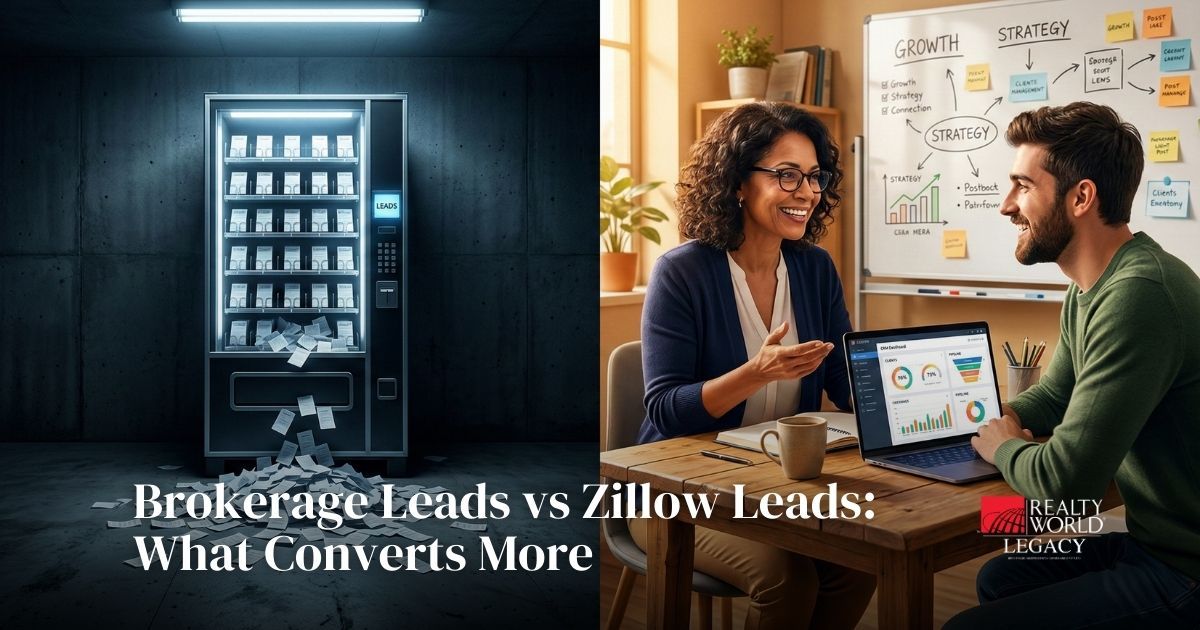
I’ve watched this play out for 25 years. Over that time, patterns became clear. After building our own in-house lead program at Realty World Legacy, one conclusion stands out: the answer depends on what you need around the leads, not just the leads themselves.
So, let me compare both real estate lead sources honestly. No sales pitch. Just the mechanics.
TL;DR: Quick Verdict
- Brokerage lead programs: Best when you want leads plus the system to convert them, including CRM, coaching, scripts, and accountability.
- Third-party leads (Zillow, etc.): Best when you already have your own follow-up system and simply need more volume.
- Bottom line: The source matters less than what happens after the lead comes in.
How Zillow Leads and Third-Party Platforms Actually Work
The model is simple.
First, you pay a monthly fee. Then the platform runs ads or captures traffic from its website. After that, leads come in and you receive names and phone numbers.
However, that’s where the service ends.
There is no follow-up system. In addition, there is no CRM setup, no scripts, and no coaching. Even worse, there are no weekly check-ins or performance reviews.
In many cases, you’re not the only agent receiving that lead. Instead, the same buyer inquiry may go to multiple agents in your area. As a result, the fastest responder wins.
Meanwhile, the platform gets paid whether you convert or not. Their business model focuses on lead volume, not lead conversion. Clearly, those are two very different outcomes.
To be fair, this isn’t a knock on Zillow or any specific platform. Rather, it’s simply how the model works. For some agents, it works fine. We’ll come back to that shortly.
For most agents, though, especially newer ones, a gap becomes obvious. You receive the leads. However, you do not receive the system required to convert them.
How Brokerage Leads Work Differently
An in-house brokerage lead program flips the model.
Instead of buying leads from a third party, the brokerage generates them internally. It runs its own ads, controls targeting, manages the CRM, builds automation, and coaches agents on conversion.
As a result, the leads and the system work together instead of separately.
At Realty World Legacy, here’s how we built ours.
We run targeted Facebook and Instagram ads reaching buyers who are ready to move within 60 days across Burlington, Hamilton, Halton, Oakville, and Niagara. Leads flow into a GoHighLevel CRM with a 95% done-for-you follow-up system.
After that, agents customize the final 5% with their voice and brand.
Then the coaching layer kicks in. Weekly accountability calls, script practice, and objection handling sessions are built in. In addition, monthly deep-dive training reinforces conversion skills.
Most importantly, the brokerage remains accountable for lead quality. Not just volume.
If leads in a certain area are not converting, we adjust the ads immediately. Because everything runs in-house, changes happen quickly instead of weeks later.
Third-party lead platform
You pay a fee. You receive names. Often, multiple agents receive the same lead. There is no follow-up system, no coaching, and no accountability for conversion. The platform gets paid regardless of your results.
In-house brokerage lead program
Leads are generated by your brokerage through targeted ads. Distribution is fair and scheduled. CRM and automation are built in. Weekly coaching and scripts are provided. The brokerage is accountable for lead quality, creating a two-way commitment.
Want the full breakdown of how our program works? Read: Why We Built a Real Estate Lead Conversion Program.
Brokerage Leads vs Zillow Leads: The Real Cost Comparison
When comparing brokerage leads vs Zillow leads, most agents focus on cost per lead.
However, that’s the wrong number.
Instead, the number that actually matters is cost per conversion. In other words, what does it cost to close one deal from a specific lead source?
Here is the math.
- 2% – Industry Conversion
- 5% – Our Target
- 2.5x – The Difference
The industry standard conversion rate for online leads is about 2%. That means for every 100 leads, you close roughly 2 deals.
At Realty World Legacy, our target is 5%. That is 2.5 times higher.
Not because the leads are better. Instead, because the system behind them is designed to convert.
When you factor in automation, coaching, scripts, and accountability, more leads move through the pipeline. As a result, cost per conversion drops and ROI increases.
A cheap lead that does not convert becomes expensive. On the other hand, a supported lead that closes becomes highly profitable.
Five Questions to Ask Before Choosing a Lead Source
Whether you’re evaluating Zillow, a brokerage program, or another source, these questions provide clarity.
1. Who controls the ad targeting?
If a third party controls the ads, you lose control over messaging and audience. However, if your brokerage manages them, adjustments can happen quickly based on performance.
2. Is there a follow-up system or just a list of names?
A lead without a system is simply a name. Therefore, look for automation, CRM integration, and structured follow-up.
3. Am I the only agent receiving this lead?
Many platforms distribute the same lead to multiple agents. As a result, speed becomes more important than skill.
4. Is there coaching or training available?
Leads start the process, not finish it. Without guidance, most agents struggle to convert consistently.
5. Is the provider accountable for lead quality?
This is critical. If the provider gets paid regardless of results, quality becomes secondary to volume.
Apply these questions to any lead source. The answers will reveal everything.
When Zillow Leads Make Sense (And When They Don’t)
I’m not here to say Zillow is bad. That would be misleading.
Zillow leads can work for the right agent.
If you already have a CRM, strong follow-up systems, and proven conversion skills, then adding third-party leads can increase volume. In that case, you’re fueling an engine that already works.
However, without that foundation, results become inconsistent.
New agents often struggle without structure. Meanwhile, experienced agents who lack systems may feel stuck.
Because of this, the model breaks down for many.
Leads alone are not enough. Without a system, they remain just names.
“The question isn’t where do I get leads. The question is: what happens after the lead comes in? That’s where deals are made or lost.” – Brenda McKinley, Broker of Record
A brokerage lead program provides the missing pieces. CRM. Automation. Coaching. Accountability.
That is the real difference.
See How Our Lead Program Works
100 leads every 45 days. 95% done-for-you follow-up. Weekly coaching. Two-way accountability.
Watch: How Our In-House Lead Program Compares
In this video, our team explains how we generate, distribute, and convert leads in-house.
Brokerage Leads vs Zillow Leads: It Comes Down to the System
Zillow. Realtor.ca. Facebook ads. Google ads. Referrals. Door knocking.
Every lead source works for someone. However, none of them work without a system.
At Realty World Legacy, we built the system first. Then we built the lead source around it.
Because of that, our brokerage lead program targets 5% conversion instead of hoping for 2%.
If you’re an Ontario agent comparing brokerage leads vs Zillow leads, shift the question.
Do not ask “where do I get leads?”
Instead, ask “what happens after the lead comes in?”
If that answer is strong, any lead source can work.
If not, then it’s time to fix the system.